Showing posts with label exhibit text. Show all posts

Monday, August 11, 2008

Musee du quai Branly, Paris (Lynn Grant)


While on a courier trip in June, I had a chance to see this museum, which contains the collections of the now-closed Musée national des Arts d'Afrique et d'Océanie and the ethnographic department of the Musée de l'Homme. The museum opened in 2006 and contains 267,000 objects in its permanent collection, of which 3,500 items from the collection are on display.

The building is pretty interesting, designed by Jean Nouvel, and featuring a "vertical garden" by Patrick Blanc.


It's also surrounded by a lovely horizontal garden. And the interior starts out interestingly, with a snail- (or Guggenheim-) like ramp spiraling around an open storage area. This quickly deteriorates into a long, uphill slog, with little visual interest and way too many speeding children plunging down the straightaways. Once I finally reached the exhibit areas, I found them frustrating. The lighting levels are low, as appropriate for an ethnographic collection, but the dark walls and floors make it hard to see the artifacts clearly, even when all the lights are working, which was often not the case. (In the special exhibit on Paracas textiles, so many lights were out that it was impossible to see some of the most important artifacts, or many of the labels - I really wanted a flashlight.) All the more frustrating because there were some fantastic artifacts in their collections, including many from Claude Levi-Strauss's personal collection.

The wonderful artifacts were all too often not fully identified (no tribal affiliations for many of the Native American pieces, for instance) or were displayed in strange juxtapositions. For instance, one case included a Sioux warshirt, a Umatilla parfleche, an Acoma pot, a Chancay textile, and a Tiwanako stone block. The theme of the case (I tried guessing, without reading the labels, with no success) was "Duality of the Sexes" making a point about male art being figurative and female art abstract. !?!* It was like a post Grad course in Anthropology. And we think our labels are too hard for our visitors! Did you know that beads and weaving are all metaphors for language? Or that "all containers evoke the idea of vitality, because living bodies are made of blood, flesh, bone, viscera, and a soul". Too ethereal for me - I just like looking at objects, so it was a relief to move on to their Crystal Skull, (labelled clearly as a modern fake but attracting a lot of adolescent attention).

The African collections were also wonderful but similarly hard to see and appreciate. I noticed glass shards in one of the cases, a result of using untempered plate glass vitrines, and having seams where visitors leaning on the glass would cause such damage. I spent several minutes trying to find a gallery attendant and trying to figure out how I could convey the message when I couldn't remember the French word for broken ('il y a quelque pieces du verre dans ce vitrine la'?) but finally gave up and decided to just be a tourist.
Final score Collections: A; Exhibit: C; Upkeep: F
Photography was not permitted but I got a *great* guide to the collections, full of color images, for only 15 Euros. Let me know if you'd like to have a look

Monday, March 24, 2008

The Mummer Museum

The Mummer Entraceway with the most recent winners


The Mummer Museum opened in 1976. If you open another window with the website, you can actually listen to String Band Music while you read this. I don't really know the difference between String Bands and Fancy Brigades and the Comics. So I will admit that while I went to the Museum to entertain a teenage cousin, I was indeed hoping to learn something new. However, I don't really think that it has been updated, other than the substitution of a newer costume here and there, since 1980. I won't lie: I enjoy putting on a costume that has been bedazzled with countless sequins and feathers as much as the next guy, but if you wanted to actually LEARN about the Mummers, I'd steer clear of the text panels.


At the top of the stairs, you enter a small hallway and are greeted by a figure in costume that looks kind of dated, but you hope its not a portend of the rest of the space.


Inside the warehouse like space, similar to the spaces where these creations are manufactured, there are photo murals on the walls and random snippets of costumes with no real labels all over a room with lots of natural lighting. I know these are pirates. But I don't know which club made them, what year they were worn, if they won awards, or if they belong to a fancy brigade [let alone what a fancy was]. Arrrrgh.


This the first text panel you see out of the giant warehouse-like space. And the light has burned out the panel: The Origins of Mummery. I *know*. I was disappointed as well.


It kind of looks like a Fun House, and really, why shouldn't it? What you are really seeing is that not a lot of the lightbulbs work. On the left? A series of "questions" and you can hit a button to see the answer. 2 of the 8 worked.


I don't know what was 5 degrees in 1918 and 62 in 1973, I just know that information stopped around then.


"these" are Mummers. There is a chance that one of the lit up featured folks was working on a Pan Am plane


Though they seem fancy, in that different images light up at various times, its obvious there once was a third of these outlines that no longer works at all. And while I like a period mustache as much as the next museum visitor, it seems like this part could be easily updated.


The highlight, of course, is being able to don a costume seen in a recent parade. I still have no idea if a Fancy Brigader, a String Bander, or a Comic wore this, but with those feathers and that hat? I can't say that I didn't have a good time.


Sunday, February 10, 2008

Perusing the PMA (Steve Lang)

pe · ruse

-verb (used with object) -rused - ru · sing

1. to read through with thoroughness or care

2. to read.

3. to survey or examine in detail


I visited the PMA to look at their Tibet gallery. It was small but nice and had some interesting features. As mentioned in the MET entry, they are actively using laminated cards in the galleries to explain iconography and the science behind conservation and dating techniques:


They also had a few maps on the wall. One showed where Tibet was located. I really liked the smaller map in the left corner, showing you where the larger map is within Asia. This is good for locating the geographical closeness of Tibet to India and China but also shows site specific locales that may be important to the context of the objects.


Another map on the wall took a small excerpt from a painting and broke it down, identifying what the images were within the actual painting itself.


There was also a Tibetan charm on paper with a number of objects in front of a deity. The text panel tells you that these objects are on the altar as well. I enjoyed the fact that they had a pictorial representation of the object, followed by an actual example of that object. This way you can get an idea of what the image represents in real life. I think this is important because often times the painting of the object doesn't capture the detail and beauty of the object itself. I am particularly interested in how artists portray objects in different mediums, so this was a welcome feature.


As mentioned in the Reading Public Museum entry, they also had a little area stocked with books and a video for learning more about the objects in the gallery itself. I am a fan.


Wednesday, January 16, 2008

Gallery extras (Lynn Grant)

Both the Fitzwilliam and the British Museum had large scrims in many of their galleries that detailed current research and activities. I (naturally) noticed that many of these featured conservation, while others were about scientific analyses. The first two are from the Fitzwilliam; the others from the BM (clicking on the photos will enlarge them for better legibility).


Monday, December 3, 2007

Musings from the MET (Steve Lang)

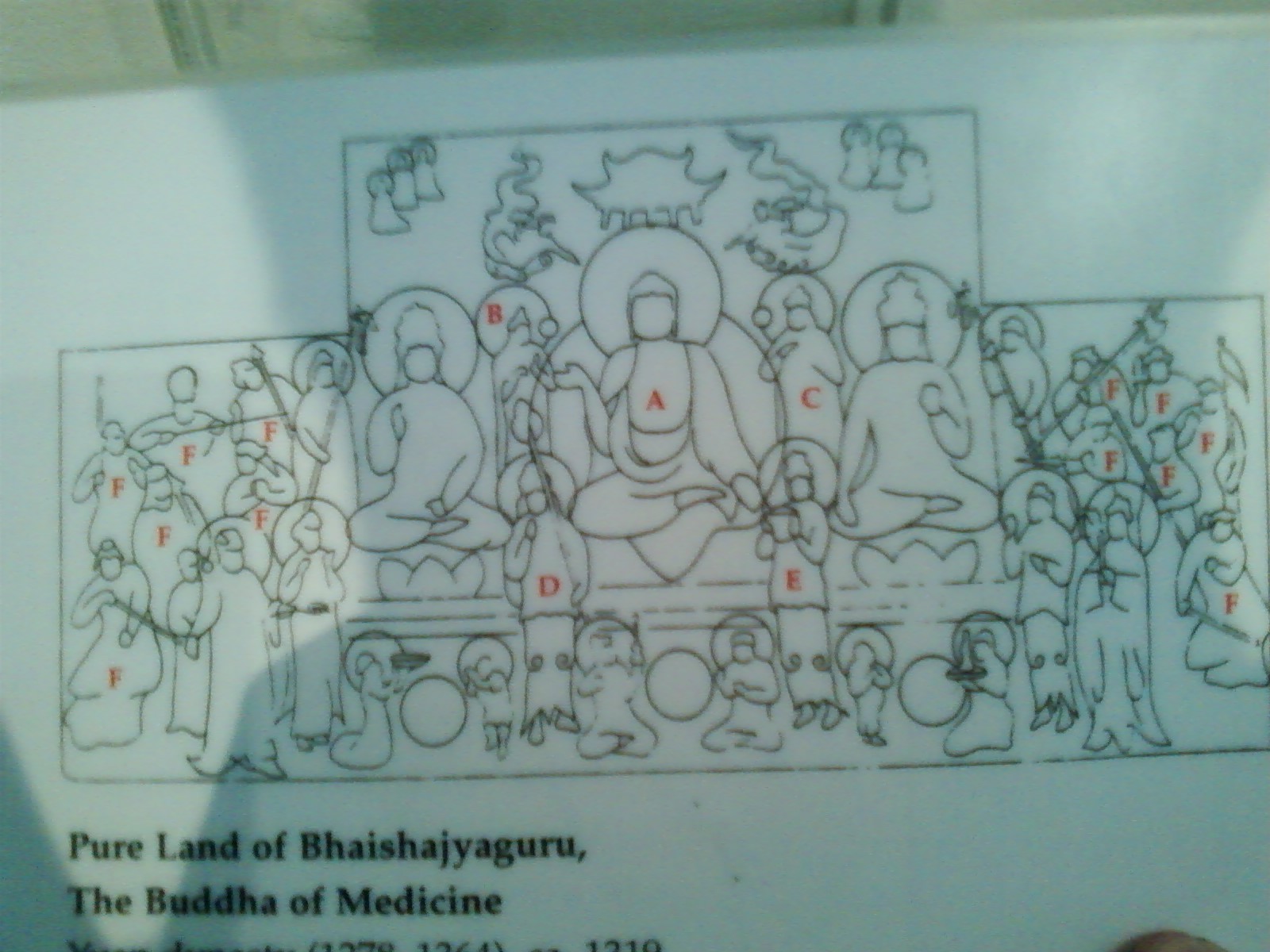
I visited the MET last weekend and saw some good things and some bad. First, I saw that they have a laminated card to the left and right of their wall painting. You could take the card and then stand back from the actual painting and read what it had to say.


The card had a diagram of the painting itself and identified the figures in the painting:


Our paintings in the Rotunda are very similar and could benefit from a similar set up. Currently you have to read the label close up and then take a step back to see the whole painting. Would people walk off with them?

I went through the rest of the Asian section, impressed by the collection. However when I got to the end of the Asian galleries, what did I see? This:

Objects in an elevator! That must be one smooth ride.

I also took a look at the Ur-nammu Stele:

I blew right past it because I thought it would be bigger having seen the 10 ft. reproduction, but eventually I found it and took a picture of it. Looking at this photo, I wish the steles in the Rotunda had enough lighting so you could see the inscriptions, but we also have paintings hanging in there so that could be an issue.

We originally had lights on the back of C284 but they actually blinded you from reading the inscription instead of illuminating it. Lesson learned: Lighting is crucial. Perhaps we could have laminated sheets with the inscriptions? But scholars really want to see the actual inscription, I'm still thinking about it.

___________________________________________________


As a side note, if you want to subscribe to the blog as an RSS feed, you can go to the bottom of the page where it says: Subscribe to: Posts (Atom) Right click on the Posts (Atom) part and click copy link location. You can then paste that into any RSS feeder. I am using the one in Thunderbird, my mail client, but you can use others.